
The decision library / Original worked example
Start with watt-hours.
Build the energy worksheet before choosing the equipment.
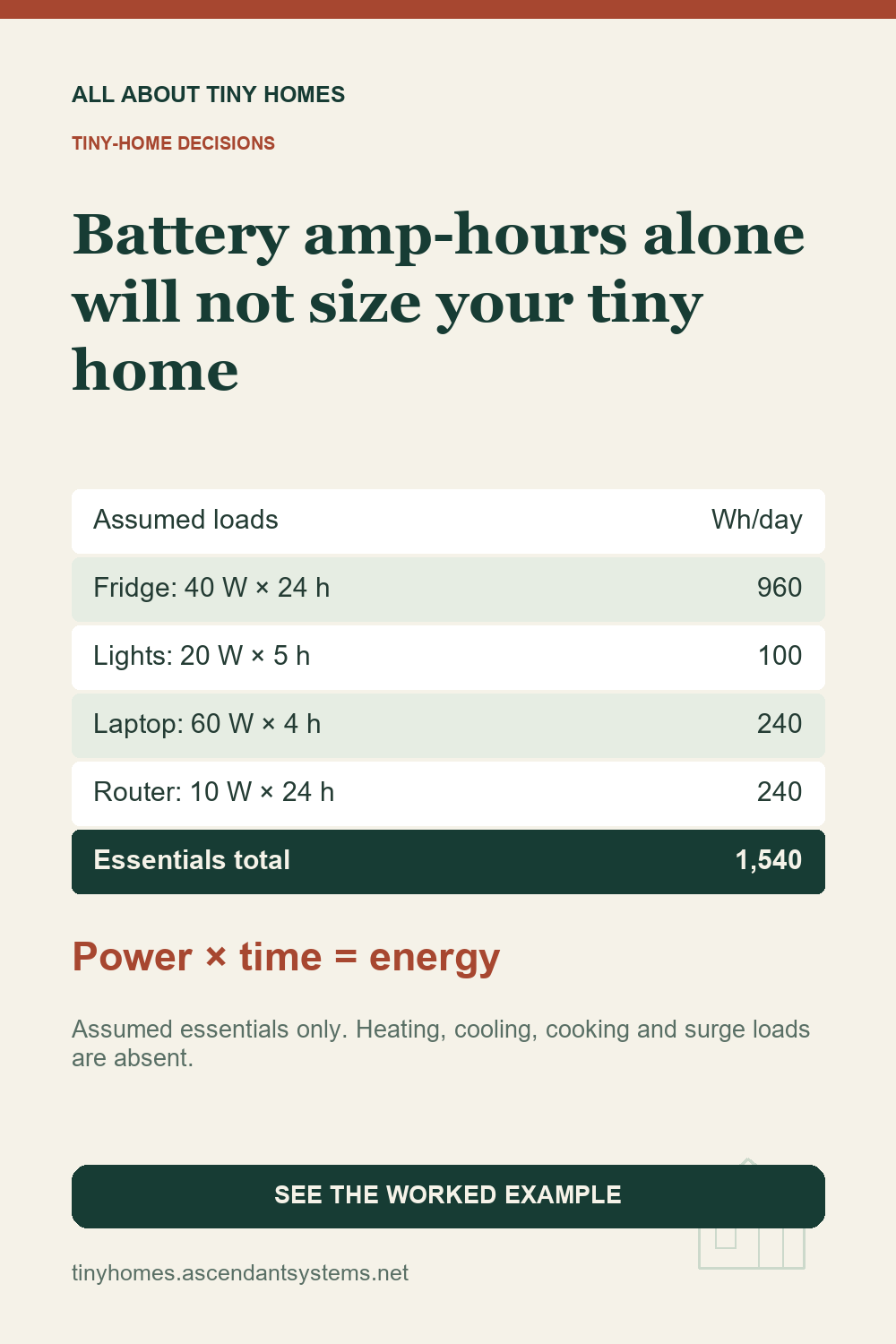
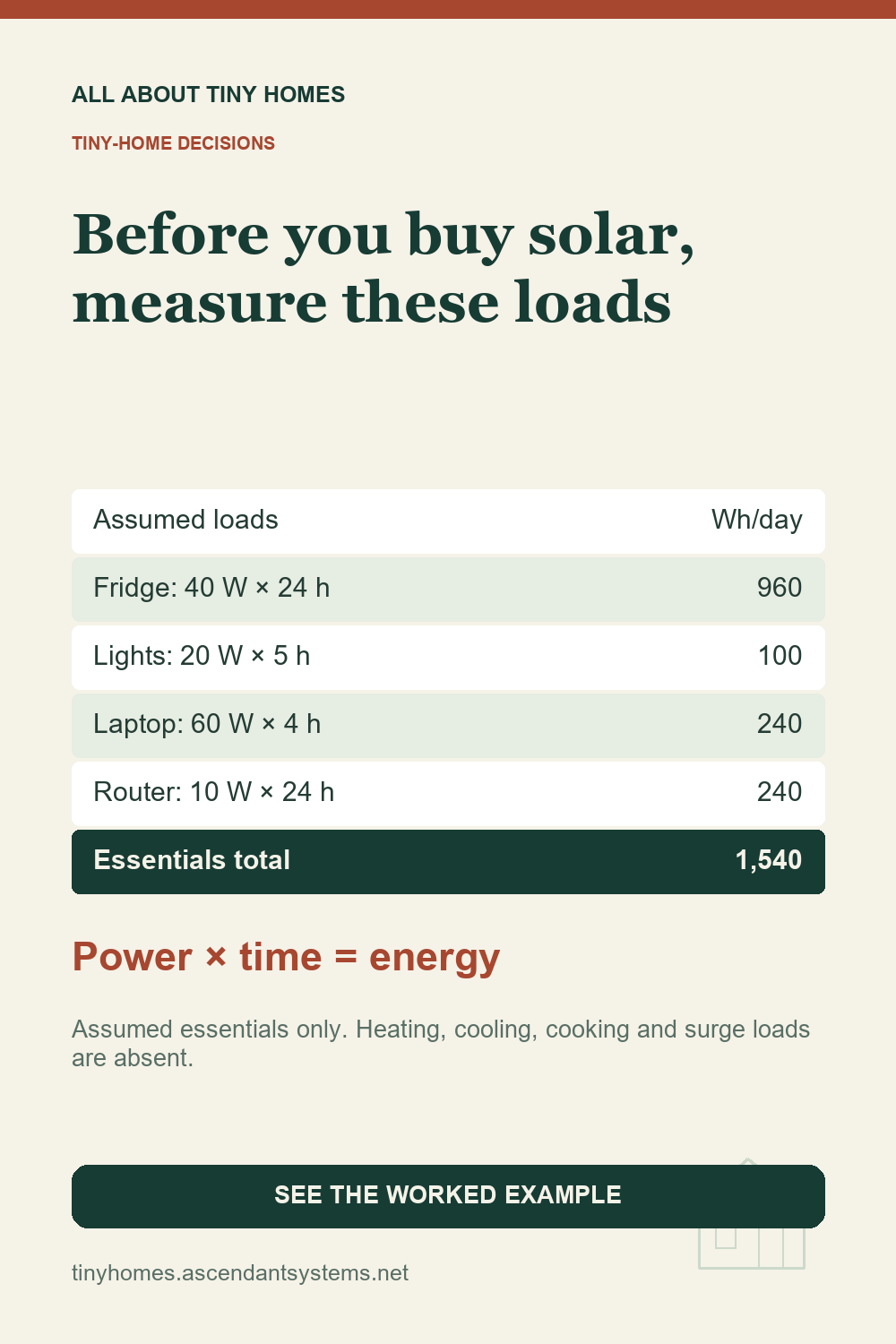
Four assumed loads. Heating, cooling, cooking and water heating are absent.
| Illustrative load | Assumed average W × hours | Wh/day |
|---|---|---|
| Fridge | 40 × 24 | 960 |
| Lights | 20 × 5 | 100 |
| Laptop | 60 × 4 | 240 |
| Router | 10 × 24 | 240 |
| Essentials-only total | 1,540 |
Measure the load you actually use.
Power multiplied by time gives energy: watts × hours = watt-hours. A device that cycles on and off needs a measured daily use or a defensible average, rather than assuming it runs continuously at its maximum label power. Virginia Tech’s energy-use guide explains this calculation and the difference between running and cycling appliances.
Show every capacity assumption.
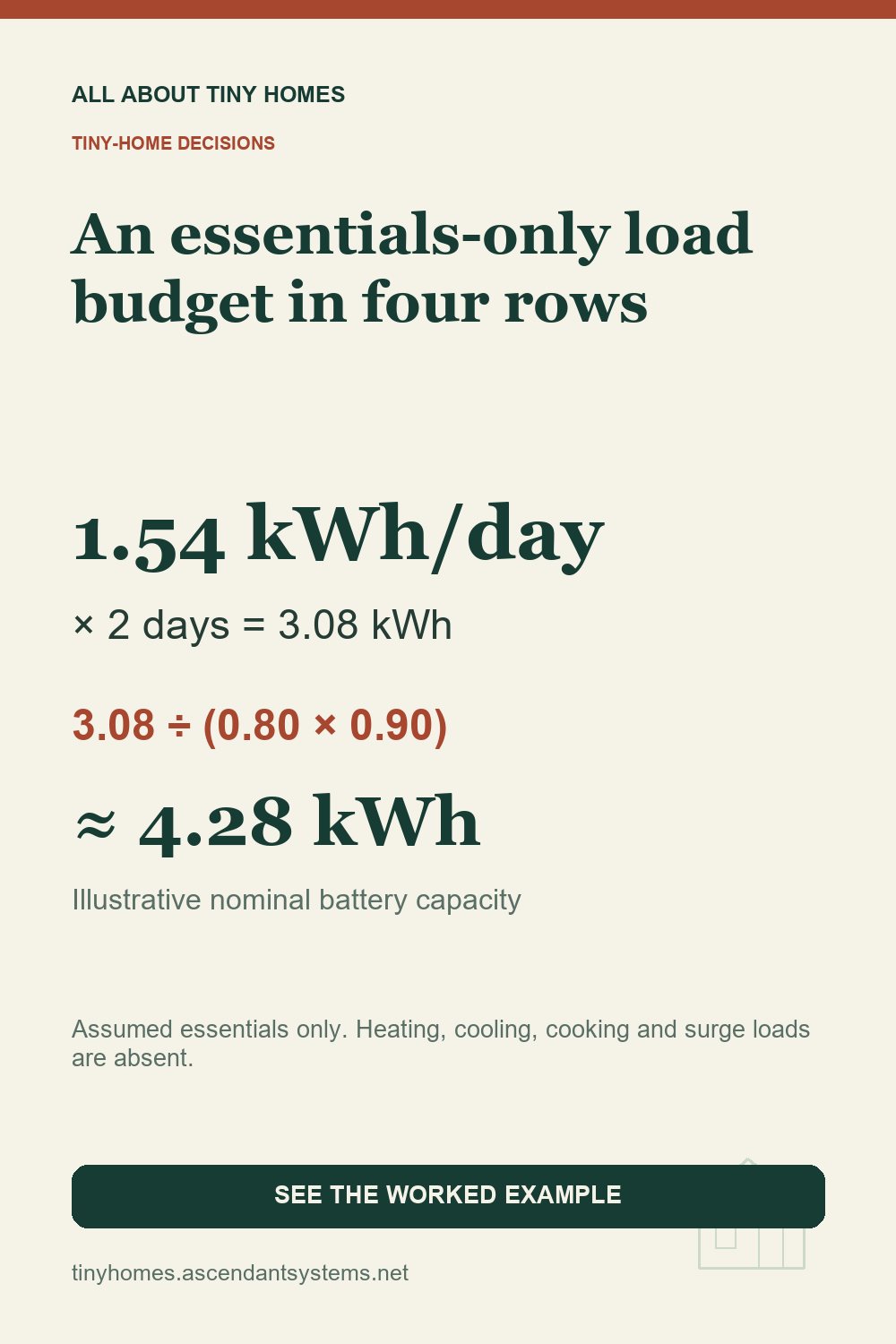
Our original four-load example uses 1,540 Wh per day. Two days require 3,080 Wh at the loads. If we assume an 80% usable battery fraction and 90% inverter efficiency, nominal capacity is 3,080 ÷ (0.80 × 0.90) = 4,277.78 Wh, or about 4.28 kWh. Those fractions are illustrative inputs, not specifications for a particular product.
Give the system designer the complete picture.
Add measured heating, cooling, cooking, water heating, pumps and every other intended load. Record surge requirements, temperature conditions, recharge opportunities and required autonomy separately. Battery capacity alone does not specify an inverter, a solar array, protection equipment or installation. Have the complete system designed for the actual site before buying equipment.
Use the table as a method example. It does not size a whole tiny home or establish that a specific product will support it. Method source checked October 13, 2026.
Watch the method.
Original illustration. Michael synthetic narration.
Read the video transcript
Before choosing a battery, add up energy use. In our essentials-only example, the fridge, lights, laptop and router use fifteen hundred forty watt-hours a day. Two days need three thousand eighty watt-hours. Now account for the assumptions: eighty percent usable battery capacity and ninety percent inverter efficiency. That works out to about four point two eight kilowatt-hours of nominal battery capacity. It is a worksheet, not a complete home design. Heating, cooling, cooking and surge loads are missing. Measure your actual appliances, record the assumptions and have the full system designed before buying. Start with the energy budget, then compare equipment.
Keep the useful part
Save the key points.
Three visual summaries for your planning notes. Download a PNG or open the full-size card. The figures are illustrative; use the worked example above and your own inputs for the next decision.
Battery amp-hours alone will not size your tiny home
An essentials-only load budget in four rows
Before you buy solar, measure these loads
Put the method to work
Make the next decision yours.
Use your own figures in the free planner. Compare supplier scope and track the contract you choose with the $39 Decision Kit.