
The decision library / Original worked example
The price of the home is the beginning.
Build a move-in budget that keeps the missing pieces visible.
An illustrative known subtotal. Land, tax and financing still need answers.
| Cost line | Illustrative USD |
|---|---|
| Home quote | 80,000 |
| Delivery | 7,500 |
| Site preparation | 18,000 |
| Permits and fees | 2,500 |
| Utility connections | 6,000 |
| Finish work | 3,000 |
| Known subtotal | 117,000 |
| Contingency on selected work | 2,700 |
| Known subtotal with contingency | 119,700 |
Write the exclusions beside the price.
Start with a dated home quote and mark each cost as included, separately quoted or unknown. Keep the delivery address, home specification and intended use consistent. A price becomes useful when you know what it covers.
In this original example, the six cost lines add to $117,000. We apply 10% contingency only to site preparation, utilities and finish work: $27,000 × 10% = $2,700. The resulting $119,700 is a known subtotal. Land, applicable tax, financing and any unquoted work remain open.
Stop the double counting.
If site preparation already includes a utility trench, do not add the same trench again under connections. Ask the issuer to split the scope or mark it included. Treat an unknown amount differently from a confirmed zero.
Take three questions into your next call.
- What is included in this exact specification, at this delivery location?
- Who supplies, pays for and coordinates the work outside your quote?
- Which figures are firm, allowances or still subject to a site assessment?
One real illustration of why exclusions matter: Indigo River’s planning tool lists delivery, specified transaction charges and finance costs outside its calculator. That is its own scope statement, not a rule for every builder. Checked October 13, 2026.
Watch the method.
Original illustration. Michael synthetic narration.
Read the video transcript
An eighty-thousand-dollar tiny home does not mean an eighty-thousand-dollar project. Here is an example, using made-up numbers so you can see the method. Add delivery, site preparation, fees, utility connections and finishing, and our known subtotal is one hundred seventeen thousand dollars. A contingency on selected site and finish costs adds another twenty-seven hundred. But stop here: land, tax and financing are still unknown. Do not quietly turn those blanks into zero. Get your actual quotes, check for overlap, and enter them in the All About Tiny Homes planner. Save the result before your next builder call.
Keep the useful part
Save the key points.
Three visual summaries for your planning notes. Download a PNG or open the full-size card. The figures are illustrative; use the worked example above and your own inputs for the next decision.
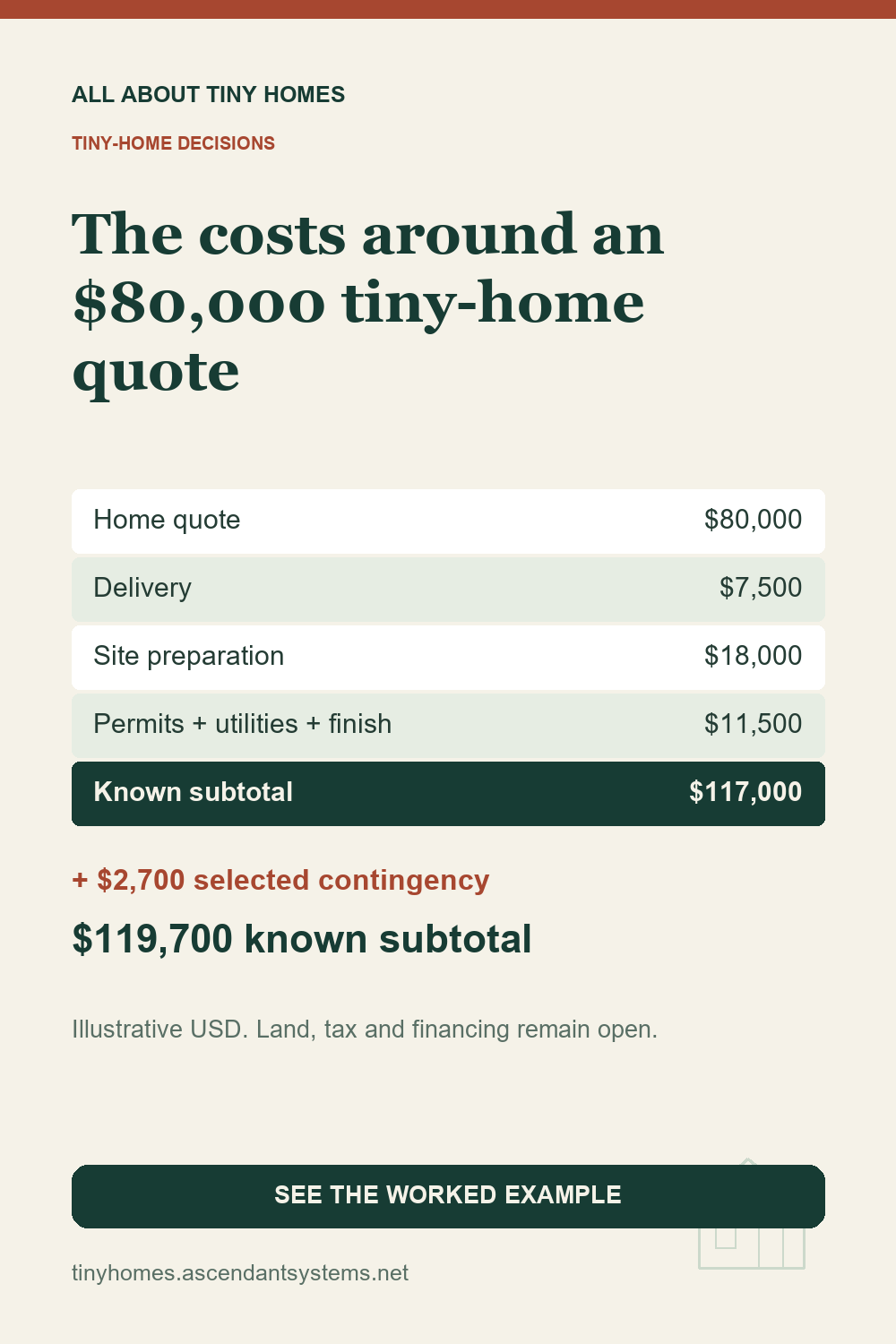
The costs around an $80,000 tiny-home quote
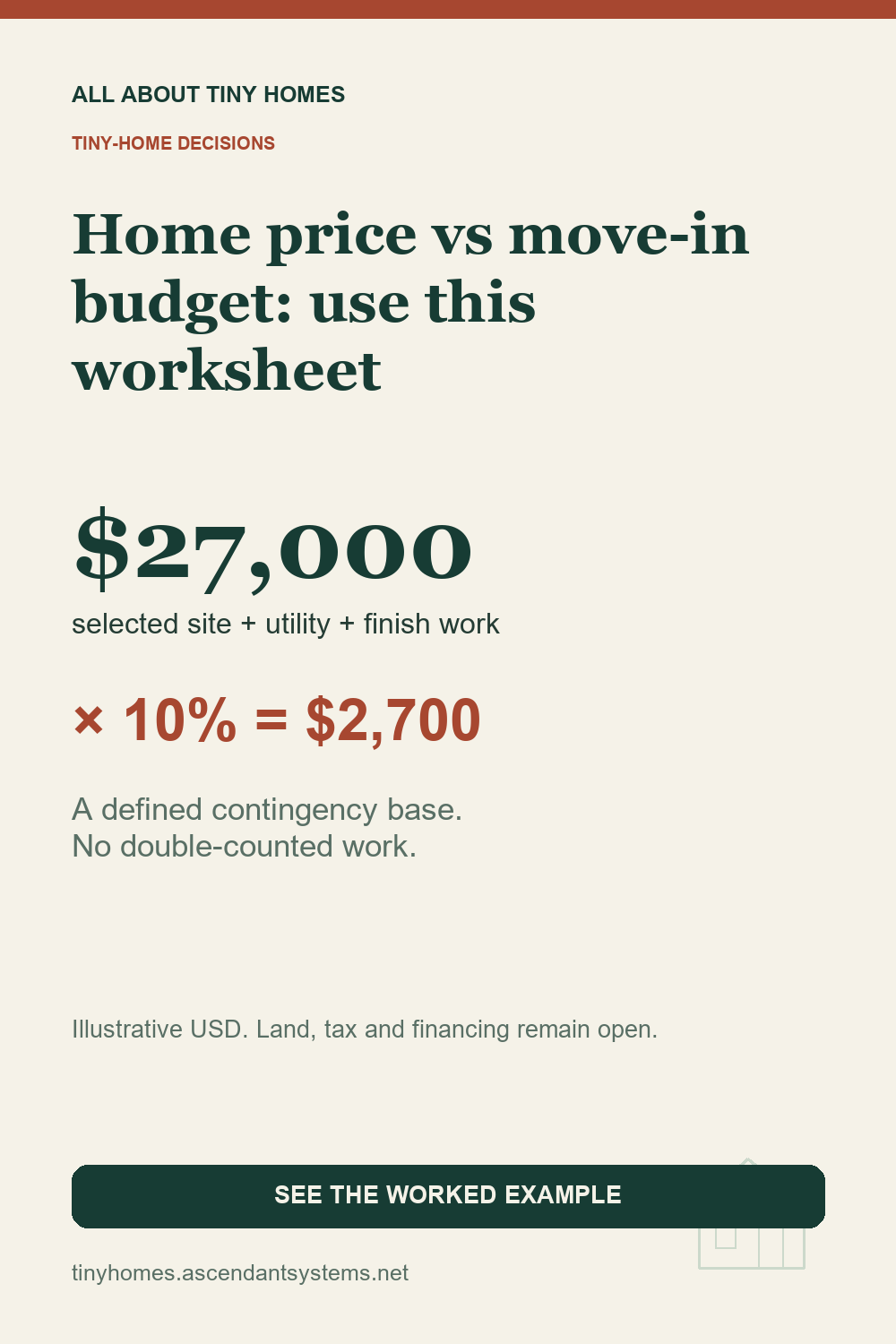
Home price vs move-in budget: use this worksheet
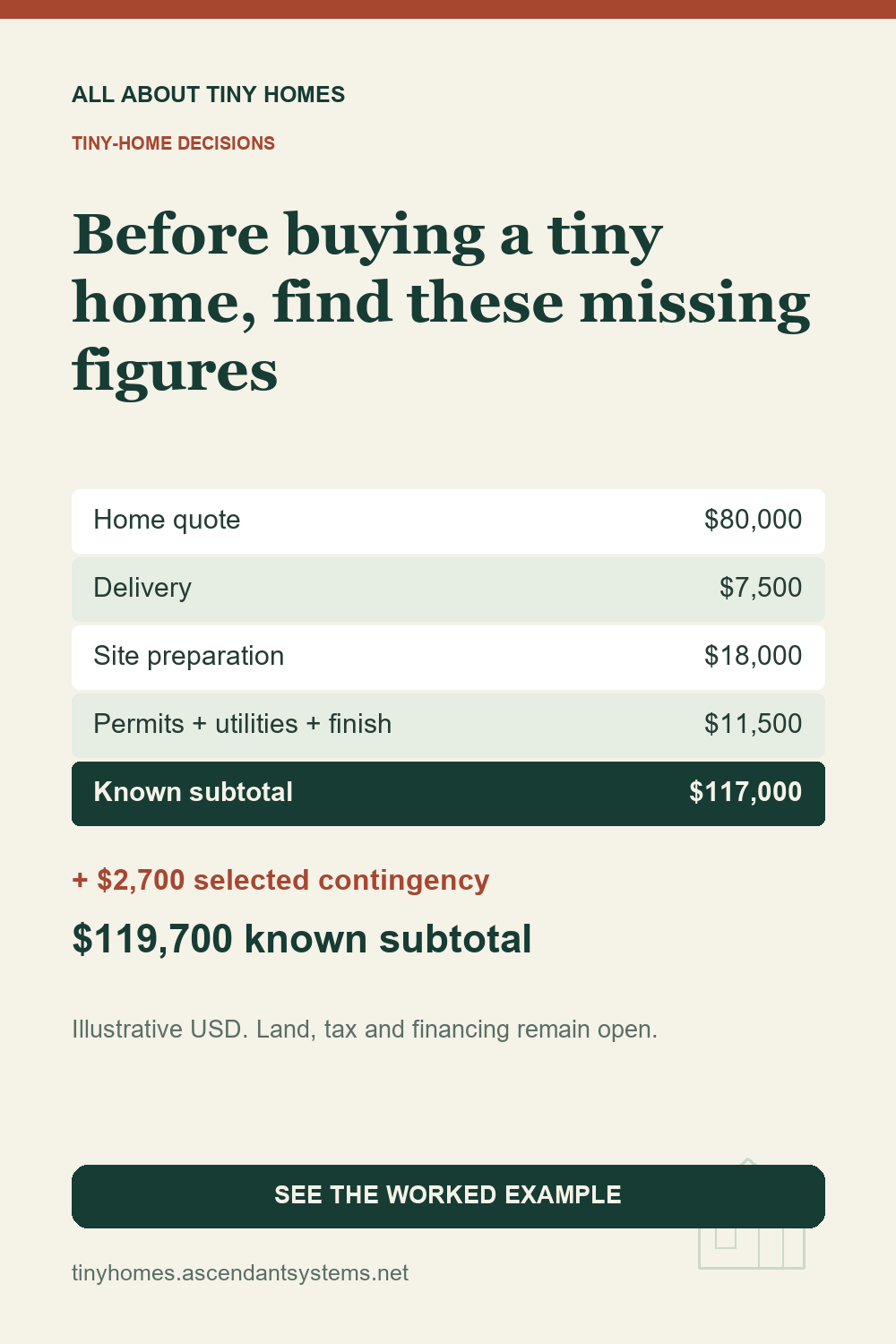
Before buying a tiny home, find these missing figures
Put the method to work
Make the next decision yours.
Use your own figures in the free planner. Compare supplier scope and track the contract you choose with the $39 Decision Kit.